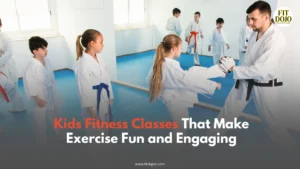
Kids Fitness Classes That Make Exercise Fun and Engaging
FIT DOJOS
Expert Team,
FITDOJOS.COM
Tell a child, “It’s time to exercise,” and you may get the same facial expression they reserve for broccoli or cleaning their room.
Tell them, “We’re going to kick pads, learn a new move, race through a challenge and earn the next skill,” and suddenly movement sounds a lot more interesting.
That is the real advantage of good kids fitness classes. They do not make children feel as though they are completing a workout. They turn movement into something social, challenging, playful and worth looking forward to.
For parents searching for better fitness, confidence, discipline, karate for kids, or practical self-defense skills, the right class can tick several boxes at once.
Families exploring age-appropriate martial arts can start with FitDojo’s parents and kids martial arts programs, which provide a useful starting point for understanding how structured training can support movement, confidence and family participation.
Why Kids Fitness Classes Need to Feel Fun
Children rarely care how many calories they burned in a session.
They care whether they got to move, play, learn something cool, laugh with other kids and leave feeling like they achieved something.
That matters.
Good kids workout classes use short activities, games, challenges, partner drills, skill practice and clear goals to keep children engaged. Instead of repeating the same movement until boredom arrives, the class constantly gives them a reason to pay attention.
Martial arts does this particularly well.
A child may be practising balance while holding a stance, coordination while kicking a pad, cardiovascular fitness during movement drills and concentration while listening for the next instruction.
To them, it is not “cardio.”
It is karate.
Much better branding.
What Are the Benefits of Fitness Classes for Kids?
Parents often ask, what are the benefits of fitness classes for kids?
The obvious answer is physical fitness, but that is only part of the picture.
Regular physical activity for kids can support:
- ❤️ Cardiovascular fitness: Active games, drills and continuous movement challenge the heart and lungs.
- 🤸 Coordination and balance: Jumping, changing direction, kicking and controlled footwork help children understand how their bodies move.
- 💪 Strength and movement skills: Bodyweight movements and martial arts drills can develop useful physical foundations.
- 🧠 Focus: Children practise listening, remembering sequences and responding to instructions.
- 🌱 Confidence: Learning a skill that once felt difficult can create a genuine sense of achievement.
- 🤝 Social skills: Group classes give children opportunities to cooperate, take turns and train with others.
- 🥋 Discipline: Structured classes teach that progress comes from showing up and practising.
- 🛡️ Self-defense foundations: Martial arts training can introduce awareness, controlled technique and responsible use of physical skills.
The World Health Organization recommends that children and adolescents aged 5 to 17 average at least 60 minutes of moderate-to-vigorous physical activity per day across the week. That does not mean every child needs a formal 60-minute workout daily. Walking, active play, sport, games and structured training can all contribute.
For families especially interested in discipline as part of that development, FitDojo also explains how karate discipline can support children’s growth.
What Age Should Kids Start Fitness Classes?
Another common question is, what age should kids start fitness classes?
There is no single perfect age.
The better question is whether the activity is designed appropriately for the child’s developmental stage.
A three-year-old should not be expected to train like a ten-year-old. Younger children usually benefit from short instructions, playful movement, simple coordination exercises and plenty of encouragement.
Parents of preschool-age children can explore FitDojo’s little kids karate classes, which are designed around younger students and age-appropriate participation.
Older children can handle more structured technique, combinations, partner work and goal-based progression. For school-age students, kids karate classes can combine movement, technique, confidence and discipline in one structured activity.
Age matters, but good coaching matters more.
Why Martial Arts Works as Physical Activity for Kids
If your child hates jogging around a field for no apparent reason, you are not alone.
Martial arts gives movement a purpose.
A child steps forward because they are practising distance. They squat because they are improving their stance. They move quickly because they are responding to a drill. They practise kicks because there is a target waiting for them.
That variety can make karate, kickboxing and other martial arts especially engaging forms of physical activity for kids.
A session might include:
- 🥊 Pad work
- 🦶 Kicking drills
- 🤸 Movement games
- 🧠 Reaction exercises
- 🥋 Technique practice
- 🏃 Short fitness challenges
- 🤝 Partner activities
Older students and families curious about striking-based training can also explore FitDojo’s kickboxing classes, while adults who want to train alongside their children or build their own fitness can look at adult martial arts classes.
For parents searching online for a mixed martial arts dojo, martial arts studio, self-defense classes or “karate classes near me,” it is worth looking beyond the style name.
Ask what your child will actually be doing in class.
Real-Life Example: From “I Don’t Want to Exercise” to “Can We Go Again?”
Picture an eight-year-old named Sam.
Sam spends plenty of time sitting after school and is not particularly interested in organised sport. His parents suggest exercise. He says no. They suggest running. Bigger no.
The problem: exercise sounds like a chore, and Sam does not feel confident joining a competitive team.
The solution: his parents try a beginner martial arts class instead.
The warm-up includes movement games. Then the students practise a basic stance, hit pads, learn a kick and complete a simple reaction drill.
Sam is exercising, but nobody keeps reminding him that he is exercising.
More importantly, he gets small wins.
His kick improves.
The instructor notices.
Another student gives him a high five.
By the end, he is sweaty, smiling and asking when the next class is.
That story is illustrative rather than a promise that every child will react the same way. But it shows why engagement matters. The best activity is not simply the one that looks impressive on paper. It is the one a child is willing to return to consistently.
For parents wondering what those first sessions are actually like, the guide on what parents should know before a first martial arts class provides useful preparation.
What Good Kids Workout Classes Should Include
Not every children’s fitness program is automatically a good one.
Parents should look for several practical signs.
Age-Appropriate Coaching
Instructions should match the child’s age and experience. Younger children need simple cues. More experienced students can handle greater technical detail.
Safe Progression
Kids should learn control before speed, complexity or harder contact.
Variety
Good classes rotate between learning, movement, games, drills and challenges.
Clear Progress
Children often stay motivated when they can see improvement through skills, levels, belts or achievable goals.
Positive Instruction
Coaches should correct mistakes without embarrassing children.
A Supportive Group
The atmosphere matters. Children should feel challenged, not intimidated.
As children get older, the structure should evolve too. FitDojo’s teen karate program gives older students a pathway into training that reflects their stage of development rather than treating every age group the same.
Fitness, Confidence, Discipline and Self-Defense Skills in One Activity
Most parents are not searching for exercise purely because they want their child to complete more burpees.
They usually want something bigger.
Maybe their child needs confidence.
Maybe they struggle to focus.
Maybe the parents want them to be more active, build discipline, make friends or develop basic self-defense skills.
Martial arts can combine those goals within one structured activity.
A child learns that technique improves through repetition. They learn to listen before acting. They discover that being strong does not mean behaving aggressively.
Parents interested in the practical side of martial arts can read more about karate styles for self-defence.
That combination is one reason families often consider martial arts instead of a conventional gym-style workout.
How Parents Can Help Kids Stay Active
Parents have influence here, but enthusiasm works better than pressure.
Try a few simple approaches:
- 🎯 Let your child try different activities before deciding what fits.
- 👏 Praise effort and consistency rather than comparing them with other children.
- 🚫 Avoid coaching every movement from the sidelines.
- 🗓️ Build activity into the weekly routine so movement becomes normal rather than occasional.
- 👨👩👧 Consider an activity the family can participate in together if that suits your household.
- 🗣️ Ask what your child enjoyed after class, not only what they learned.
Consistency usually grows when children feel some ownership over the activity.
Parents who want to understand FitDojo’s broader training approach, instructors and community can visit the About FitDojo page.
Make Kids Fitness Classes Something Children Actually Look Forward To
Kids do not need to fall in love with “working out.”
They need to discover that moving their body can feel good, build confidence and actually be fun.
That is what effective kids fitness classes should deliver.
Whether your family is interested in karate for kids, fitness, discipline, confidence or practical self-defense, structured martial arts can give children a reason to move while teaching skills they can continue developing over time.
And when the question changes from “Do I have to go?” to “Are we training today?”, you know you may have found the right activity.
Ready to Try a Kids Fitness Class?
Reading about the benefits is useful, but the easiest way to judge a class is to see how your child responds to the real experience.
A good first session should feel welcoming, active and structured, without expecting a beginner to know everything on day one.
Interested in seeing whether FitDojo is the right fit for your child?
Book your trial class at FitDojo and let your child experience the training environment first-hand.
Similar post
September 28, 2026
How Martial Arts Develop Leadership Skills

September 10, 2026
Why Sparring Fear Happens Even When You Know the Techniques