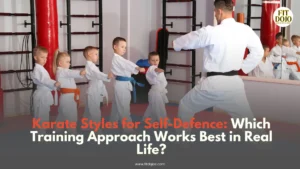
Karate Styles for Self-Defence: Which Training Approach Works Best in Real Life?
FIT DOJOS
Expert Team,
FITDOJOS.COM
As soon as one starts looking into different karate styles, one will get lost in various acronyms like Shotokan, Goju-Ryu, Kyokushin, Wado-Ryu, Shito-Ryu, and many others. Very soon, selecting a martial art will seem even more difficult than hitting your first punch.
You have trained for months now and are able to perform fast punches, good stances, and powerful combinations. And then someone throws you the uncomfortable question: “But what if someone attacked me would this training work?”
And here is the helpful piece of information: in terms of practical self-defense, it is important which martial art you practice, but even more important is how you practice it.
A good martial arts studio not only trains you to land punches and kicks, but also to be aware of space, to think fast and to act decisively under pressure.
🥋 The best karate is not simply the style with the toughest reputation. It is the training approach that prepares you to stay composed when things stop being comfortable.
Why Karate Styles Matter When Self-Defence Is the Goal
Fights in real life do not start with people bowing to each other, making sure of the compliance with the rules and readiness of all participants.
They may be unexpected, chaotic and difficult. For this reason, realistic self-defence training requires a combination of certain skills, not just one spectacular move.
- 🛡️ Awareness: recognising trouble early enough to avoid it.
- 👣 Distance: understanding when you are safe and when you are within striking range.
- ⚡ Timing: reacting efficiently rather than simply reacting quickly.
- 🧠 Composure: making sensible decisions while your heart rate climbs.
- 🥊 Practical technique: practising strikes, blocks and movement with a partner.
- 🏃 Fitness: having enough conditioning to keep functioning under pressure.
The traditional method is still important. Through kata, basics, and drilling techniques, coordination, balance, and body mechanics are built. However, if self-defense is your aim, these abilities must be applied to the controlled drills with partners, timing exercises, and gradual resistance.
For the beginners who wonder what their first lessons will entail, here is the guide on what to expect before a first martial arts class to make entering into the dojo much less intimidating.
Self-defense is not about winning on the street. Staying away from danger, distancing oneself, de-escalating a conflict and getting to a safe place constitute success.
🥋 Train to protect yourself, not to prove yourself.
How Many Styles of Karate Are There?
Many people wonder what the number of styles of karate is, but unfortunately, it does not have an exact figure as there have been many founders of this form of martial art and many schools, associations and lineages, thus creating many recognized styles of this martial art throughout the globe. When ordinary beginners speak of the main styles of karate, on the other hand, they mean Shotokan, Goju-Ryu, Wado-Ryu and Shito-Ryu, along with Kyokushin being one of the famous styles of karate.
The various types of karate can be likened to cousins rather than strangers because they share a lot of martial arts gene.
Shotokan: The Long-Range Technician
Shotokan is one of the most recognisable karate styles. Training commonly emphasises strong fundamentals, powerful linear techniques, structured kata and control of distance.
For self-defence, those habits can help students understand positioning, balance and how to deliver decisive techniques efficiently.
Its effectiveness still depends on how those fundamentals are practised. Beautiful technique against fresh air is not quite the same challenge as dealing with another person who moves, reacts and refuses to stand still.
🥋 Shotokan teaches the weapon; realistic practice teaches when and how to use it.
Goju-Ryu: Comfortable When Things Get Close
Goju-Ryu reflects the concept of combining “hard” and “soft” methods. Its approach includes powerful techniques alongside circular movement, breathing methods and close-range applications.
That makes it particularly interesting for self-defence because confrontations do not always stay at a comfortable kicking distance.
🥋 When distance gets smaller, good structure becomes a big advantage.
Kyokushin: Learning to Function Under Pressure
Kyokushin is most known for its physically intense training and combat sports. Its focus on conditioning and enduring situations through strength can instill skills that are useful for the moment when a student meets physical resistance.
Nevertheless, competition and self-defense have their differences. Rules of sports cannot be applied in real life, thus training must incorporate aspects such as caution and decision making as well.
🥋 Toughness helps, but toughness with judgement helps more.
Wado-Ryu: Moving Instead of Meeting Force Head-On
In Wado Ryu, much importance is given to body movement and positioning. This reveals the basic concept of self defense: that one does not have to always counter force with equal force.
It can be especially helpful for a small person to move out of the way of the attacking person's line.
🥋 Sometimes the smartest block is not being where the attack lands.
Shito-Ryu: Building a Deep Technical Toolbox
Shito-Ryu is known for a broad technical curriculum and extensive kata practice. That variety can provide practitioners with a substantial movement vocabulary and strong technical foundations.
For practical self-defence, however, collecting techniques should never become the goal by itself. Under pressure, a few simple actions practised repeatedly are often more useful than trying to remember Technique Number 47 while your brain is shouting, “What now?”
🥋 A big toolbox is useful, but only when you know which tool you can reach under pressure.
What Makes a Style of Karate Work in Real Life?
Here is where debates about the “best” style karate practitioners should choose become much more interesting.
Imagine two students.
Alex trains in a supposedly practical style but rarely spars. Every attack arrives from an agreed angle, at an agreed speed, and politely stops when something goes wrong.
Sam trains in another style but regularly practises controlled sparring, pad work, distance management and progressively resistant partner drills.
Who is more likely to feel comfortable when something unexpected happens?
Probably Sam.
The problem: knowing techniques without knowing how to apply them against movement and pressure.
The solution: progressively practising those techniques with timing, resistance and decision-making in a controlled environment.
That does not mean every class needs to resemble a cage fight. Quite the opposite. Good coaching introduces pressure gradually so beginners can build competence rather than merely survive the session.
Cross-training can also expose students to different striking problems. For example, kickboxing classes can complement karate by introducing additional combinations, movement patterns and pressure-tested striking practice.
Students also need appropriate protective equipment as contact increases. FitDojo's guide comparing karate gloves and training pads can help families understand common equipment choices before buying.
🥋 Confidence is not downloaded at registration. It is earned through repeated evidence that you can improve.
Can Karate Build Confidence as Well as Self-Defence Skills?
One of the greatest values of karate could even arise before an individual has the need to protect themself physically.
By training consistently, a student will be presented with many chances to try something difficult, make mistakes, get feedback, and improve. This process could eventually affect how the individual presents himself in and out of the dojo.
In a meta-study conducted in 2021 analyzing 22 different studies with 5,852 martial arts participants, important correlations have been noted between self-management and such factors as confidence in exercise, satisfaction, and commitment. It is unlikely that karate would make everyone confident on its own, but scientific evidence confirms an observation that experienced martial arts teachers see all the time.
For younger students, physical development matters too. Martial arts activities involving balance, coordination, movement patterns and controlled techniques can support foundational abilities. Parents can explore this further in our guide to how martial arts can develop children's motor skills.
“You do not need to feel confident before you start. Training gives you opportunities to build confidence one small success at a time.”
🥋 Real confidence comes from competence, not pretending nothing scares you.
Is Karate a Good Fighting Style Outside the Dojo?
Yes, karate can be a good fighting style and an effective foundation for self-defence when it is trained appropriately.
The important part of that sentence is trained appropriately.
Karate can teach powerful striking mechanics, balance, footwork, timing, distance management and defensive reactions. Consistent training can also improve fitness and make controlled physical pressure feel less unfamiliar.
But no martial art gives you an invincibility cheat code.
Real confrontations can involve surprise, size differences, multiple attackers, weapons or unpredictable surroundings. Even experienced martial artists should prioritise awareness, avoidance, de-escalation and escape whenever possible.
Adult beginners who want fitness, practical skills and structured progression can explore FitDojo's martial arts classes for adults rather than worrying about becoming “good enough” before joining.
If you are curious about the people and training philosophy behind the programs, you can also learn more about FitDojo and its martial arts approach.
🥋 Karate gives you tools. Good judgement tells you when not to need them.
Choosing Karate Styles for Kids, Teens and Adults
A parent researching karate for a six-year-old probably wants something different from an adult searching for practical self-defence classes.
That is why the best martial arts program should match the person as well as the martial art.
Karate for Children
For children, useful training can develop far more than kicking and punching. FitDojo offers dedicated kids karate classes designed around age-appropriate learning and progression.
- 👦 Coordination and body control
- 🧠 Concentration and listening skills
- 🤝 Respect and positive social interaction
- 🎯 Discipline and goal-setting
- 🛡️ Age-appropriate self-defence awareness
Families with very young beginners can also explore karate classes for little kids, where activities can be adapted to shorter attention spans and early-stage coordination.
Parents comparing broader family options can review the parents and kids martial arts programs available through FitDojo.
Karate for Teenagers
Teenagers often benefit from a different balance of structure, challenge and independence. A dedicated teen karate program can provide a place to improve fitness and martial arts skills while developing confidence, discipline and resilience.
Karate for Adults
Adult students may place more emphasis on fitness, practical striking, stress relief and self-defence.
- 💪 Strength and conditioning
- 🥊 Practical striking ability
- ⚡ Reactions and movement
- 🧠 Confidence under pressure
- 😌 Mental focus and stress relief
🥋 The right class should challenge you enough to grow, not overwhelm you enough to quit.
Choose the Martial Arts Studio Before Obsessing Over the Karate Style
If you are searching online for “karate classes near me”, “self-defence classes” or a “mixed martial arts dojo”, do not choose solely from the style written above the front door.
Visit the dojo. Watch how instructors coach beginners. Notice how students treat one another. Ask how practical skills progress from basic technique to partner work.
A good martial arts studio should be able to explain:
- 🥋 How beginners learn fundamentals safely
- 🥊 Whether students practise controlled partner resistance
- 🛡️ How self-defence differs from competition
- 👨👩👧 How training changes for children, teenagers and adults
- 📈 How students progress from basic technique towards practical application
- 🤝 How instructors maintain a respectful and supportive environment
Practical matters count as well. Before choosing a school, families may want to understand typical martial arts class pricing and what is normally included in membership.
New students may also need a gi or other training clothing. Our guide to martial arts uniforms and what beginners should know explains some of the common options.
Be cautious of anyone promising that one secret technique or supposedly unbeatable karate style will make you untouchable.
Martial arts do not work through magic. They work through coaching, repetition, feedback, appropriate resistance and consistency.
🥋 Do not hunt for a mythical perfect style. Find a dojo where you can actually become better.
Finding Practical Karate and Self-Defence Training
If you are considering karate because you want greater confidence, discipline, fitness or practical self-defence skills, you do not need to arrive at your first class already confident, flexible or fit.
That is what training is for.
The nervous beginner walking through the doors for the first time and the experienced martial artist confidently working combinations have something important in common: both improve by continuing to show up.
So which of the many karate styles works best for real-life self-defence?
Shotokan can build excellent distance management and fundamentals. Goju-Ryu offers useful close-range principles. Kyokushin can develop formidable conditioning and pressure tolerance. Wado-Ryu emphasises movement and evasion. Shito-Ryu offers significant technical depth.
But the winner is not simply a name.
The most useful approach combines quality instruction, consistent practice, progressive resistance, fitness, awareness and responsible decision-making.
“Don't choose karate because you want to become fearless. Train until you know what to do even when fear turns up.”
Ready to Find the Karate Training Approach That Fits You?
Reading about different karate styles can take up your entire day, but the surefire way of getting is by participating in a session yourself.
If you need self-defence, physical fitness, discipline or increased confidence either for yourself or your child, the very first class that you will participate in provides you with an opportunity to meet the instructors and get a feeling for the training itself.
🥋 Ready to put theory into practice? Book your free martial arts trial at FitDojo and take the first step towards stronger skills, greater confidence and practical self-defence training.
Similar post
September 28, 2026
How Martial Arts Develop Leadership Skills
September 10, 2026
Why Sparring Fear Happens Even When You Know the Techniques