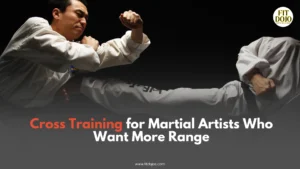
Cross Training for Martial Artists Who Want More Range
FIT DOJOS
Expert Team,
FITDOJOS.COM
Cross training allows martial artists develop more than the strengths and weaknesses of one form of training. You can maneuver, react, and make decisions with greater confidence over a variety of areas by adding additional skill sets rather than giving up your foundation in karate, kickboxing, or another sport.
Anyone may possess years of experience, strong technique, strong kicks, and quick punches. Then someone gets closer, grabs you, or applies a different kind of force, and all of a sudden situation appears totally different.
Cross-training is capable of making martial arts more beneficial, difficult, and exciting for anyone practicing for self-defense, discipline, fitness, or confidence.
One martial art gives you a foundation. Cross training teaches you what to do when the situation changes.
What Does Cross Training Mean in Martial Arts?
Cross-training martial arts, simply means training in multiple combat sports so that skills support one another in some way.
To learn about ground fighting, a student could learn Brazilian jiu-jitsu. To improve their comfort level with punches, kicks, combos, a professionals may take kickboxing classes
A striker might learn wrestling or judo to understand clinch control, balance, takedowns, and how to stay on their feet when someone tries to close the distance.
However, gathering strategies like trading cards is not the key to successful cross-training. You work alongside trained teachers who can assist you in improving an actual weakness or missing area.
Think of your main martial art as your first language. Cross training helps you become multilingual.
Why Do Martial Artists Cross Train?
One of the main motives is straightforward: Each martial art has a focus.
Karate can help improve striking mechanics, timing, distance, coordination, discipline and controlled movement. Boxing is very much about punching, footwork, combinations and defensive reactions. Wrestling is all about takedowns and control, while Brazilian jiu-jitsu teaches you positional awareness and submissions on the ground.
Actual experiences don’t respectfully remain in a single category. Distance changes. Someone may grab, push, clinch, fall, or attempt to take another person to the ground.
A Simple Cross Training Example
Think of a karate student who feels good striking at kicking and punching distance. In a match with an experienced grappler the partner closes distance, clinches up and performs a takedown.
The issue isn't that the student's karate unexpectedly stopped being effective. The issue was that the scenario entered into a range where the student had a lack of experience.
The answer? Effective cross-training. Grappling sessions can be added to a karate student’s training to help detect takedown attempts, improve their balance, comprehend ground positions, and stay more composed when an opponent gets in close range.
Students who want to strengthen their base can also explore adult martial arts training while adding complementary skills gradually.
Finding a gap in your training is not failure. It is a roadmap for what to learn next.
What Are the Benefits of Cross Training?
What are the benefits of cross training? The answer goes far beyond learning a few extra techniques.
1. More Complete Self-Defense Skills
Self-defense can involve several ranges. Awareness and avoidance come first, but if physical contact becomes unavoidable, the situation may involve striking, grabbing, clinching, falling, or ground contact.
Cross training exposes you to more of those problems in a controlled environment. If practical self-defense is one of your goals, learning about different karate styles for self-defense can also help you understand how training approaches vary.
2. Broader Fitness
Different martial arts challenge the body in different ways. Kickboxing can demand repeated explosive striking and cardiovascular endurance. Grappling adds pulling, gripping, pushing, positional strength, and sustained resistance.
Karate can develop speed, balance, mobility, coordination, and technical precision. Moving between styles changes the physical stimulus and can make fitness training feel less repetitive.
3. Better Problem-Solving Under Pressure
Sparring and grappling are physical puzzles. If one approach does not work, you need to adapt quickly rather than freezing or repeatedly forcing the same technique.
4. Confidence Based on Experience
There is a major difference between hoping you could cope with an unfamiliar situation and having safely trained through similar pressure many times.
Cross training helps replace uncertainty with experience, which can create a more grounded form of confidence.
More tools do not guarantee success. They give you more intelligent choices.
Cross Training for Karate: Fill the Gaps Without Losing Your Base
One common misconception about cross training for karate is that you must abandon traditional training and turn yourself into an MMA fighter.
You do not.
Karate can remain your foundation. If you value its striking, movement, discipline, traditions, and technical detail, keep developing those qualities.
Students who want to sharpen the fundamentals further may also benefit from studying karate positions and movement fundamentals.
Complementary Styles for Karate Students
- 🥊 Boxing or kickboxing: Useful for combinations, defensive reactions, footwork, and sustained striking exchanges.
- 🤼 Wrestling: Develops takedowns, balance, clinch control, and takedown defense.
- 🥋 Judo: Adds throws, grips, off-balancing, and controlled falling skills.
- 🔒 Brazilian jiu-jitsu: Introduces positional control, escapes, submissions, and ground awareness.
The goal is not to become average at five different martial arts overnight. Build depth first, then add useful breadth.
Keep your roots. Grow more branches.
MMA Cross Training Connects the Ranges
MMA cross training provides one of the clearest examples of why combining disciplines can be useful.
Mixed martial arts asks a practitioner to understand several connected ranges instead of treating each one as an isolated skill.
- 🥊 Striking range
- 🤝 Clinch range
- 🤼 Takedowns
- 🔒 Ground control
- ⬆️ Returning safely to standing
The difficult part is often not knowing individual techniques. It is learning how to transition between them.
A strong striker might know exactly what to do while punching and kicking but become uncomfortable when an opponent changes levels for a takedown. A skilled grappler may feel excellent on the ground but struggle to enter safely against strikes.
Cross training teaches those worlds to connect.
Knowing the ranges is useful. Knowing how they connect is better.
How to Start Cross Training Without Burning Yourself Out
Discovering another martial art can be exciting, and that excitement can make students try to train everything at once.
Karate Monday, grappling Tuesday, kickboxing Wednesday, wrestling Thursday, and regret by Friday is not a sophisticated training plan.
- Keep your primary discipline consistent. Continue developing the martial art where you already have your strongest technical foundation.
- Identify one genuine weakness. Ask whether you need better striking, clinch work, takedown defense, ground control, mobility, or conditioning.
- Add one complementary class. One additional session each week can be enough when you are beginning.
- Give yourself time to adapt. New movement patterns will often feel awkward at first.
- Protect recovery. Sleep, nutrition, mobility, and rest are part of effective martial arts training.
- Review your progress. After several months, ask whether your additional training is genuinely helping your goals.
Students who need more individual attention may find private martial arts classes useful for addressing specific weaknesses without dramatically increasing weekly training volume.
Train wider, not recklessly.
Cross Training for Kids, Teens, and Families
Cross training can also benefit children and teenagers when it is introduced in an age-appropriate way.
A strong kids karate program can build fundamentals such as coordination, listening, controlled movement, persistence, and respect before students begin exploring broader skills.
Very young students may benefit more from structured karate classes for little kids that focus on movement, confidence, attention, and basic technique rather than complicated cross-training schedules.
As children grow, dedicated teen karate classes can introduce greater technical complexity, physical challenge, and responsibility.
What Parents Should Watch For
- 👀 Are instructors patient with beginners?
- 🛡️ Is contact controlled and appropriate for age and experience?
- 🤝 Are students paired responsibly?
- 🥋 Is discipline taught without humiliation?
- 📈 Is progress encouraged without unnecessary pressure?
Parents who are new to martial arts may also want to read what parents should know before a first martial arts class.
For families who want to participate rather than simply watch from the sidelines, parent and kids martial arts classes can turn training into a shared experience.
Strong martial arts training develops people first and fighters second.
How Cross Training Builds Discipline as Well as Skill
Cross training can be humbling. You might be experienced in one martial art and suddenly become the beginner again when you enter another class.
That experience can be valuable. You have to listen, accept correction, practice fundamentals, and resist the temptation to rely only on what already feels comfortable.
That is closely connected to the way karate develops discipline through repetition, consistency, patience, and gradual improvement.
Cross training also reminds experienced students that martial arts learning never really ends.
The moment you become a beginner again, you discover how much more there is to learn.
Choosing the Right Martial Arts Studio for Cross Training
Searching for karate classes near me, a mixed martial arts dojo, or self-defense classes can give you plenty of options. The harder part is identifying which school deserves your time.
What to Look for Before Joining
- ✅ Qualified instructors who can explain what they teach and why.
- ✅ Clear safety standards and controlled training practices.
- ✅ Structured progression for beginners.
- ✅ Respectful students and instructors.
- ✅ Clean facilities and training equipment.
- ✅ Opportunities to try a class before making a longer commitment.
If you are looking specifically for karate Rockdale training, you can explore karate training in Rockdale and compare the class structure, coaching approach, and environment with your own goals.
Students interested in a broader combat-training environment can also look at martial arts programs in Rockdale.
A quality school should help you understand the training rather than pressure you into joining before you know what you are signing up for.
Choose the quality of the coaching before the quantity of styles on the timetable.
Can Online Training Replace Cross Training in a Dojo?
Online instruction can be useful for reviewing terminology, studying technique, improving mobility, or revisiting material you already understand.
It becomes more limited when you need timing, resistance, distance, live reactions, or feedback from another person.
If you are deciding how much martial arts can realistically be learned away from the dojo, read this guide on learning karate online.
Cross training works best when techniques are tested safely with qualified coaching and appropriate partners.
Videos can show you a technique. Training partners show you whether you can actually use it.
More Range, More Options, More Confidence
Cross training is not an admission that your martial art is ineffective. It is simply recognition that martial arts is a very big world.
Karate might give you distance, timing, discipline, and striking. Grappling can introduce another kind of pressure. Kickboxing can sharpen combinations. Wrestling can change your understanding of balance and control.
Put those experiences together thoughtfully and something useful happens: you stop trying to force every problem into the same solution.
That is where cross training martial arts becomes valuable for everyday students, not just professional competitors. It can make training more engaging, challenge your fitness, expose weaknesses safely, strengthen self-defense skills, and build confidence based on experience.
If you want to understand the instructors, training philosophy, and community behind Fit Dojo, visit the Fit Dojo About Us page.
The goal is not to know every martial art. It is to become a more capable version of yourself.
Ready to Put Cross Training Into Practice?
You can read about striking, grappling, fitness, and self-defense all day, but martial arts begins to make sense when you actually train.
A trial class gives you the chance to meet the instructors, experience the training environment, ask questions, and see whether the program fits your goals.
Book your martial arts trial class and start building more range, more confidence, and a stronger martial arts foundation.
Similar post
September 28, 2026
How Martial Arts Develop Leadership Skills
September 10, 2026
Why Sparring Fear Happens Even When You Know the Techniques