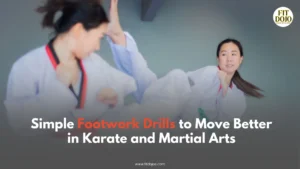
Simple Footwork Drills to Move Better in Karate and Martial Arts

FIT DOJOS
Expert Team,
FITDOJOS.COM
If you can't place your feet where you want at a right moment, then you need to work on footwork drills. Even if you have strong defense, speed punches, and explosive kicks, improper footwork might make you unbalanced, out of range, or slow to respond.
You may improve your positioning, speed, balance, and range control with a proper footwork drills. This guide will teach you basic karate and other martial arts routines, as well as the principles, common errors, and useful techniques to enhance your movement properly.
Why Footwork Is Important in Martial Arts
Footwork is not moving just forward and backward, it's more than that. It describes your spot in regard to your opponent and specifies whether or not you can move away, attack, or defend. There should be an objective for each step. Movement has an impact on nearly every skill you practice, no matter if you are training in kickboxing, karate, or another martial art.
Balance and Stability
A good stance gives you a foundation, but maintaining that foundation requires solid footwork.
Think about delivering a reverse punch with your feet twisted or too near to one another. Even with proper hand technique, you will find it difficult to produce force and could be more easily knocked off balance.
Practice moving while maintaining a steady stance width. Instead of leaving one foot behind, your feet must work together..
Distance and Range Control
Your opponent might be just a few centimeters away from your effective range. In this case, your posture could be impacted if you reach for them.
This issue can be resolved with one minor move. With good footwork, you can easily be at your range to attack and move away at right time before your opponent reacts.
Angles and Positioning
Moving straight backward is not always your best defensive option. Stepping diagonally or pivoting can move you away from an attack while placing you in a better position to counter.
This is also an important part of practical movement for real-world self-defense, where positioning and awareness often matter as much as the technique itself.
Speed and Agility
Fast feet are useful, but controlled feet are more important.
Speed should develop after you can move without crossing your feet, losing your stance, or bouncing unnecessarily. Start slowly, develop correct movement patterns, and then increase the pace.
Quick takeaway: Good footwork keeps you balanced, controls distance, and puts you in better positions to attack or defend.
Fundamentals to Learn Before Practicing Footwork Drills
Before trying advanced footwork drills, make sure your basic movement is sound. Repeating poor mechanics at high speed only reinforces bad habits.
Fighting Stance and Foot Placement
Start from the fighting stance used in your martial art. Karate stances vary depending on style and situation, while boxing, Muay Thai, taekwondo, kickboxing, and MMA use different positions.
Regardless of style, your stance should allow you to move without having to completely reset your feet first.
When practicing general movement, avoid repeatedly bringing your feet together or crossing them unless a specific technique requires it.
Weight Distribution and Balance
Avoid placing so much weight on one leg that changing direction becomes difficult.
Your ideal weight distribution depends on your martial art, stance, and situation. A karate fighter preparing for a fast lead-leg kick may distribute weight differently from a boxer preparing to punch.
The important principle is mobility. You should be able to move, attack, or defend without fighting against your own stance.
Keep Your Steps Controlled
Beginners often assume bigger steps mean faster movement. Usually, oversized steps create the opposite problem.
Large steps can stretch your stance, affect balance, and make changing direction slower. Use controlled steps that allow the second foot to follow naturally and restore your fighting position.
Quick takeaway: Build speed on top of balance and control, not instead of them.
Essential Martial Arts Footwork Techniques
Most effective footwork is built from a relatively small number of movement patterns. Learning these gives you a foundation that can later be adapted to your martial art.
Forward and Backward Movement
To move forward from a typical fighting stance, the front foot generally moves first and the rear foot follows. When retreating, the rear foot generally moves first, followed by the front foot.
This helps prevent your legs from crossing and allows you to maintain your stance.
Lateral and Diagonal Movement
Side-to-side movement helps you avoid becoming an easy target on a straight line.
Diagonal steps can be especially useful because they change both your distance and angle. Instead of moving directly backward from an attack, you may be able to step diagonally away and create space for a counter.
Shuffle and Sliding Footwork
Short shuffles and sliding movements allow you to adjust distance without dramatically changing your stance.
Karate practitioners may recognize sliding movements such as suri ashi, although terminology and execution vary between styles.
Pivots and Circular Movement
A pivot changes your angle without requiring a large step. Rather than constantly retreating as an opponent advances, you can sometimes pivot or circle away.
These same movement principles are often practiced differently across striking systems. If you want to explore another striking-focused training format, see our kickboxing classes.
Quick takeaway: Master simple directions first, then use pivots and angles to make your movement less predictable.
5 Simple Footwork Drills You Can Practice
You do not need expensive equipment to improve your movement. These footwork drills can be practiced in a dojo, gym, or at home if you have enough safe space.
1. Forward and Backward Drill
- Start in your normal fighting stance.
- Take one controlled step forward.
- Bring the other foot with you to restore your stance.
- Take one controlled step backward.
- Return to your starting position and repeat slowly for one to two minutes.
Watch your stance width throughout the drill. Your feet should not gradually move closer together or farther apart.
2. In-and-Out Range Drill
Place a marker on the floor or imagine an opponent directly in front of you. Start just outside your striking range, step forward until you can comfortably land a technique, then immediately move back outside range.
Begin without striking. Once your movement is smooth, add a jab, reverse punch, or another basic technique appropriate to your martial art.
Simple sequence: Enter → strike → exit → reset.
3. Pivot and Angle Drill
Stand in your fighting stance facing an imaginary opponent. Step into range, perform a simple attack, then pivot to one side instead of moving directly backward.
Reset and repeat on the other side. Start slowly enough that your feet, hips, and upper body remain coordinated.
4. Shadowboxing Footwork Drill
Shadowboxing is useful because it connects footwork to realistic attacks and defensive movements.
Set a timer for two minutes. Move forward, backward, laterally, and diagonally. Add attacks only when your feet have placed you in an appropriate position.
If you want to combine movement with more structured striking sessions, these kickboxing workouts provide additional ways to train technique, conditioning, and combinations.
5. Partner Mirror Drill
Stand opposite a training partner at a safe distance. One person leads while the other mirrors the movement.
The leader moves forward, backward, left, and right while maintaining their stance. The follower tries to maintain the same distance.
Start slowly for 30 to 60 seconds before increasing the pace. This introduces something solo training cannot fully reproduce: reacting to another person's unpredictable movement.
Quick takeaway: The best drills connect clean movement with distance, angles, attacks, and reactions.
Offensive vs Defensive Footwork
Footwork becomes much more useful when you stop treating it as an isolated exercise and connect it to a purpose.
Offensive Footwork
Offensive movement helps you reach an opponent while maintaining a position from which you can attack effectively.
Instead of leaning forward to reach a target, use your feet to close the distance. You can also step or pivot after your first attack to create an angle for the next technique.
Example: Step into range → attack → angle to the side → attack again or exit.
Defensive Footwork
Defensive footwork creates space or changes your position when an attack is coming.
Moving backward is one option, but it should not be your only response. Lateral steps, diagonal movement, pivots, and controlled exits can make you harder to pressure.
The goal is not simply to escape. Good defensive movement should leave you balanced enough to respond.
Quick takeaway: Offensive footwork finds opportunities, while defensive footwork removes you from danger and prepares your response.
Common Footwork Mistakes and How to Fix Them
Practicing frequently will not help much if you repeatedly practice the same mistakes. Pay attention to these common problems.
- Crossing your feet: This can compromise your balance. Slow down and practice which foot initiates each direction.
- Taking oversized steps: Shorten your movement until you can stop or change direction immediately.
- Letting your feet come too close together: Maintain enough stance width to stay stable.
- Looking at your feet: Practice slowly until you can move while keeping your eyes forward.
- Losing your guard: Your hands should not drop simply because you are concentrating on your feet.
- Moving without purpose: Ask whether you are controlling range, creating an angle, escaping pressure, or setting up an attack.
Recording yourself can help reveal habits you do not notice while training. A qualified instructor can also identify technical problems specific to your martial art and style.
For younger students, structured practice can also reinforce focus, discipline, and movement habits. Explore our kids karate classes, and teen karate training for age-appropriate instruction.
Quick takeaway: Clean up mistakes at slow speed before trying to perform the same movement faster.
How to Improve Your Martial Arts Footwork
One common question is, “How can I improve my footwork quickly?”
The answer is consistent, focused practice rather than trying to move as fast as possible from day one.
Start with five to ten minutes of dedicated movement practice. Work on stance and basic steps first, then introduce angles and pivots. After that, combine movement with punches, kicks, or other techniques before progressing to reactive partner drills and sparring.
Another common question is, “Can I practice footwork at home?” Yes. Basic movement, shadowboxing, pivots, and range drills can be practiced in a clear, non-slip area. Partner drills and technical corrections are better performed under appropriate instruction.
- Practice the movement slowly.
- Perform it smoothly without looking at your feet.
- Increase speed.
- Add a technique.
- Add an unpredictable partner.
- Apply it during controlled sparring.
Martial arts development involves more than physical technique. Consistent training can also support qualities such as leadership skills and character building, especially when students learn to practice with patience, responsibility, and discipline.
Quick takeaway: Progress from correct movement to fast movement, then from predictable drills to realistic reactions.
Start Practicing These Footwork Drills
Better martial arts movement is built through repetition, but the quality of those repetitions matters. Focus first on stance, balance, controlled steps, distance, and angles. Then use footwork drills to connect those fundamentals to attacks, defense, and real reactions.
You do not need to practice everything at once. Pick two drills from this guide and spend five to ten minutes on them during each training session. Once they become comfortable, add pivots, combinations, partner reactions, and sparring applications.
Most importantly, use drills as a bridge to actual martial arts practice rather than an end in themselves. Work with a qualified instructor when possible so your movement fits the techniques, style, and rules you are training for. You can learn more about our instructors and training philosophy on the FitDojos About Us page
Move with balance, move with purpose, and make every step put you in a better position.
Want to put these footwork drills into practice with experienced instruction? Take the next step and book your free martial arts trial to experience a class and start improving your movement in a structured training environment.