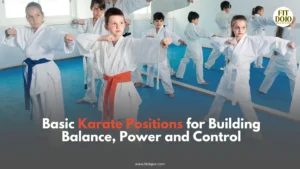
Basic Karate Positions for Building Balance, Power and Control
FIT DOJOS
Expert Team,
FITDOJOS.COM
Learning the basic positions in karate means laying the groundwork for balance, technique, movement, and control. When first learning karate, it is essential to get posture and balance right before anything else, speed and power will come in later sessions. There are many variations of positions across different karate styles, so good coaching is a must.
A good position of the feet, knees, hips, and upper body means that the student will be stable enough for punches, blocks, kicks, and movement. If you have taken up karate for gaining confidence, discipline, physical fitness, or self-defense, then learning good positioning is among the first things to learn.
What Are Karate Positions?
Karate positions generally relate to the body positioning adopted by learners when executing techniques. One might also come across the Japanese term dachi when the instructor refers to stances or posture.
Positioning is much more than just placing one’s feet in a certain way. The knees, hips, center of gravity, and direction all play an important role in making the position effective. The position adopted in karate should ensure that one stays balanced and ready for execution of techniques.
Why Karate Positions Matter for Beginners
Basic karate positions is the foundation for everything that will make you easier to learn different combinations. If your position is unstable then you will have weak punch and kick. Similarly, incorrect foot position will make changing direction more difficult and slower.
Following are the things student can develop leaning Karate positions:
- Balance: You become better at controlling your centre of gravity while standing and moving.
- Power: Stable positioning allows more of the body to contribute to a technique.
- Control: Good posture helps you start and stop movements deliberately.
- Coordination: Your upper and lower body learn to work together.
- Movement: Strong stances help you transition between techniques more smoothly.
This is why instructors often spend considerable time correcting a beginner's feet before worrying about how impressive their punches look.
Adults who want to build these fundamentals in a structured environment can start with adult martial arts classes.
Common Karate Position Names Beginners May Learn
The exact karate position names and how they are performed can vary between styles and organisations.
Shotokan, Goju-Ryu, Shito-Ryu, Wado-Ryu, and other karate systems may emphasise different stances or perform similar positions with technical differences.
However, several names are commonly encountered.
1. Zenkutsu-Dachi or Front Stance
Zenkutsu-dachi is commonly known as a front stance.
The stance generally places more emphasis toward the front leg while maintaining a stable base. It appears frequently in basic techniques and kata in several karate styles.
Beginners should pay attention to the direction of the feet, knee alignment, hip position, and posture rather than simply trying to make the stance as long as possible.
2. Kokutsu-Dachi or Back Stance
Kokutsu-dachi is commonly described as a back stance.
Compared with a front stance, more weight is generally placed toward the rear leg. The exact distribution and foot positioning depend on the karate style.
It can teach beginners how changing weight distribution affects balance, movement, and technique.
3. Kiba-Dachi or Horse Stance
Kiba-dachi is often called horse stance.
The feet are positioned apart, creating a strong lateral base. Students may encounter the position in basic training, kata, or conditioning exercises.
Holding the stance can quickly show a beginner why leg strength matters in karate.
4. Neko-Ashi-Dachi or Cat Stance
Neko-ashi-dachi is commonly called cat stance.
Much of the body weight is supported by the rear leg, leaving the front foot relatively lightly weighted.
This position can challenge balance and teach students to control weight transfer carefully.
5. Musubi-Dachi
Musubi-dachi is a more natural upright stance where the heels are together and the toes point outward.
It may be used during formal moments such as bowing, depending on the style and dojo.
It looks simple, but posture still matters.
What Is the Karate Starting Position?
There is not one universal karate starting position used for every exercise, kata, style, or competition.
Beginners sometimes expect karate to have one standard "ready pose." In reality, the starting position depends on what you are doing.
You might begin from a formal stance for bowing, a ready position before basic drills, a specific starting stance for kata, or a more functional guard during partner practice.
Ready Positions
The Japanese term yoi is commonly used as an instruction meaning to prepare or get ready.
The exact ready position that follows can differ according to the school and exercise.
A good ready position should not mean becoming stiff. You should remain controlled, attentive, and prepared to move.
How to Build a Strong Karate Starting Position
Beginners often make the mistake of thinking lower automatically means better.
It does not.
A position needs to be stable, functional, and appropriate for the technique.
When practising a basic stance, work through these steps:
- Set your feet first. Make sure the width and direction match the stance your instructor has taught.
- Check your knees. Keep them aligned appropriately rather than allowing them to collapse inward.
- Control your hips. Avoid unnecessary twisting or leaning.
- Keep good posture. Your upper body should remain controlled rather than collapsing forward.
- Check your weight distribution. Understand where your body weight should be for that particular stance.
- Relax unnecessary tension. Stable does not mean rigid.
- Test your movement. You should be able to transition without completely losing your balance.
Practise slowly before adding speed.
Good habits become much easier to maintain when they are established from the beginning.
How Karate Positions Help Generate Power
A strong karate technique is not produced by the arm or leg alone.
The body works as a connected system.
When your stance is stable, your legs, hips, torso, and upper body can coordinate more effectively. This can help you perform techniques with greater structure and control.
Imagine trying to push something while standing on an unstable surface.
Even if your arms are strong, poor footing makes it harder to apply force effectively.
Karate uses the same basic principle. Your foundation matters.
Power Is Not the Same as Muscle
Beginners sometimes assume the strongest student will automatically have the most powerful technique.
Strength certainly has value, but karate also develops timing, coordination, body mechanics, speed, and positioning.
Learning to use your whole body efficiently is one reason students practise basic positions repeatedly.
Karate Positions for Better Balance and Movement
A stance should not trap you in one place.
Karate requires movement.
Students need to learn how to transition from one position to another without bouncing unnecessarily, crossing their feet at the wrong time, or losing posture.
A useful beginner drill is:
- Start in the stance your instructor specifies.
- Check your posture.
- Move forward slowly.
- Settle into the next stance without wobbling.
- Pause and check your feet and knees.
- Repeat backward.
- Add an appropriate block or punch only after the movement feels controlled.
This may look basic, but it develops habits that support more advanced techniques later.
Common Karate Position Mistakes
Beginners are expected to make mistakes. That is part of learning.
The important thing is correcting them before they become automatic.
Making Every Stance Too Wide
A dramatic-looking stance is not automatically a good stance.
Going wider or longer than necessary may make movement awkward and create unnecessary strain.
Follow the proportions taught by your instructor.
Looking Down at Your Feet
Beginners often stare at their feet while trying to position them correctly.
That can affect posture and awareness.
Check your feet when necessary during slow practice, but gradually learn to feel where they are without constantly looking down.
Letting the Knees Collapse Inward
Poor knee alignment can affect stability and may place unnecessary stress on the joints.
Your instructor should help you understand appropriate alignment for each stance.
Becoming Too Tense
Students sometimes tighten every muscle because they are trying to look strong.
Excessive tension can make movement slower and more tiring.
Learn when to stay relaxed and when to apply tension as part of the technique.
Forgetting the Upper Body
A stance involves more than the legs.
Leaning too far forward, raising the shoulders, or twisting unnecessarily can affect the entire technique.
Can You Practise Karate Positions at Home?
Yes, basic stance practice can be useful at home once a qualified instructor has shown you the correct technique.
You do not need much space.
Practise in front of a mirror if appropriate, move slowly, and concentrate on quality rather than completing hundreds of repetitions.
A simple home practice could include:
- Hold a basic stance for a short period.
- Check posture and knee alignment.
- Relax and reset.
- Step slowly into the same position.
- Practise transitioning between two familiar stances.
- Review corrections your instructor gave you in class.
Avoid teaching yourself complicated positions purely from pictures or short online clips.
A stance can look correct from the front while being noticeably wrong from the side.
Karate Positions for Kids
Children benefit from learning positions progressively rather than being expected to perform advanced stances perfectly on day one.
Good children's karate instruction should combine technique with age-appropriate activities that develop balance, coordination, listening, and body awareness.
For school-age children, structured kids karate classes can help build these fundamentals in a safe, progressive environment.
Very young students may benefit from little kids karate classes that focus on basic movement, balance, and listening skills.
Teenagers can continue developing stronger technique, control, and confidence through teen karate training.
For younger students, instructors may simplify explanations.
Instead of giving a long technical description of weight distribution, a teacher might use an easy visual cue or movement game.
As students mature, the technical details can become more precise.
The goal is steady development, not forcing children into uncomfortable positions to make them look advanced.
How Parents Can Support Better Karate Fundamentals
Parents do not need to correct every stance at home.
It is often more helpful to support consistency, good habits, and positive attitudes toward practice.
Families interested in training together can explore parent and kids martial arts programs.
Parents preparing a child for their first lesson may also find our guide on what parents should know before a first martial arts class useful.
Do Karate Positions Help With Fitness?
Yes, regular stance practice can be physically demanding.
Holding and moving through karate positions can challenge the legs, hips, core, balance, and coordination.
Combine that with punches, kicks, kata, partner drills, and conditioning, and karate can become a full-body activity.
Students who also enjoy striking-based conditioning may consider kickboxing classes as another way to build fitness and movement skills.
However, improvement comes from consistency.
Doing one exhausting stance session is less useful than training regularly with good technique and gradual progression.
For younger students, you can also learn more about how martial arts develop motor skills through balance, coordination, and controlled movement.
What Equipment Do You Need to Practise Karate Positions?
Beginners usually do not need much equipment to start learning stances and movement.
A clean, comfortable training space and suitable clothing may be enough for an introductory class.
As you continue, you may need a karate uniform. Our guide to martial arts uniforms explains common options for beginners.
If your training later includes sparring, your instructor may also recommend gloves or protective equipment. You can compare options in our guide to karate gloves and pads.
How to Learn Karate Positions Correctly
The most reliable way to learn is with a qualified instructor who can watch how your body actually moves.
Videos and diagrams can help you review karate position names, but they cannot always show whether your personal alignment is correct.
When choosing a karate school, look for instructors who:
- Explain techniques clearly.
- Correct beginners respectfully.
- Prioritise safe alignment.
- Teach movement as well as static positions.
- Adapt instruction appropriately for children and adults.
- Build fundamentals before rushing into advanced techniques.
Good coaching should help you understand not only where to put your feet, but why the position matters.
If you want to learn more about the instructors and training philosophy behind the school, visit the Fit Dojos About Us page.
Learning Karate Positions in Rockdale
If you want hands-on feedback instead of guessing whether your stance is correct, structured karate training in Rockdale can help you learn proper positioning from the beginning.
Students looking for a broader program can also explore martial arts training in Rockdale.
If you prefer focused one-on-one instruction, private martial arts classes can provide more individual feedback on stance, movement, and technique.
Conclusion: Strong Karate Positions Build Strong Fundamentals
Learning basic karate positions may seem simple, but they form part of the foundation for almost everything you do in karate.
Strong positions can improve balance, movement, body control, coordination, and the structure behind your techniques.
Beginners should focus on accuracy before speed. Parents should look for instructors who teach children positions safely and progressively. Every student should also remember that a stance is not supposed to be a frozen pose.
It should prepare you to move.
Want to learn karate positions correctly from the start? Book your trial class at Fit Dojos and learn proper stances, movement, balance, and fundamental techniques with real-time instructor feedback.
Similar post
September 28, 2026
How Martial Arts Develop Leadership Skills
September 10, 2026
Why Sparring Fear Happens Even When You Know the Techniques