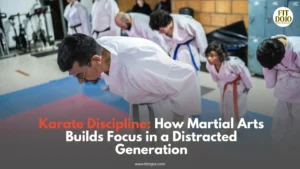
Karate Discipline: How Martial Arts Builds Focus in a Distracted Generation

FIT DOJOS
Expert Team,
FITDOJOS.COM
The discipline of karate begins with a very basic principle, learning how to concentrate even in the midst of many distractions. To children who have been brought up in the era of mobile phones, video games, and endless notifications, maintaining concentration on one single task could become difficult at times. Karate training offers a different atmosphere altogether where listening, following instructions, practicing and persisting despite difficulty become second nature to students of karate. Such seemingly little practices can prove to be very beneficial in the future.
That is one reason parents exploring karate for kids are often interested in much more than punches, kicks and belts. They want their kids to be better at listening, stick with a task when they think it is hard, control their temper and have the self-discipline necessary to see things through. When adults come to learn martial arts, they also usually have similar goals in mind.
🥋 Discipline is not something karate simply tells students to have; it is something good training asks them to practise.
What Karate Discipline Really Looks Like in Training
The term “discipline” can give a wrong impression regarding the concept of martial arts. The first thing people might imagine would be a very intimidating teacher yelling out orders as students stand there quietly, scared of doing anything wrong. It may seem very disciplined on the outside but real discipline in karate has nothing to do with intimidation and everything to do with self-discipline.
Gradually, the student will realize that there is much to be learned about self-control. If the teacher is demonstrating a technique, there is a need to pay attention. If another student is training, one has to wait for his/her turn. If one is working with a partner, he/she should control his/her strength and know where to stop. If one forgets any step in the combination or moves the wrong foot, one shouldn’t feel ashamed or discouraged.
This is a vital process since self-discipline begins to take shape once students take control of their actions by themselves and not out of fear of being watched. A beginner will need reminders to put their hands up, stay where they are supposed to be, and pay attention to demonstrations. These reminders can eventually turn into habits that students will control by themselves.
Parents preparing a child for their first lesson can also read our guide on what parents should know before the first martial arts class for a clearer idea of what beginner training can involve.
🥋 Real discipline is not being perfect the first time; it is developing the patience to improve the next time.
How Karate Disciplines Build Focus Through Repetition
As one observes a beginner executing a basic routine, the need for concentration in karate becomes obvious. For example, an instructor may tell the beginner to step forward with his left foot, keep his hands up, turn his hip when he punches, and then go back to his starting position. All these individual tasks may not seem complex, but executing them all at once is certainly difficult for a someone new at karate.
Karate is one of those martial arts where you get to experiment with several different karate disciplines. Each offers a unique opportunity to practice your skills and concentrate on particular aspects. From basic techniques requiring attention to body positions to memorizing kata sequences, practicing pad work, and engaging in various forms of partner drills, there’s no shortage of ways to hone these essential skills.
And as we grow more proficient at our chosen art form, we begin to see how each element connects to the others, physically and mentally. One of life’s most valuable lessons lies in knowing that without concentration, things can quickly fall apart, whether this be losing focus on a technique, getting into the wrong sequence of moves, failing to listen when someone calls out instructions…the list goes on! It reinforces just how vital good old fashioned mindfulness really is.
- 👂 Listening carefully: following demonstrations and verbal instructions.
- 🧠 Remembering: holding sequences and corrections in mind.
- 🛑 Controlling impulses: waiting for the right moment to move or respond.
- 🎯 Maintaining concentration: staying with one task long enough to improve it.
- 🔄 Resetting attention: returning to the task after distraction or mistakes.
- 🤝 Respecting partners: controlling power and following safety rules.
- 📈 Persisting: continuing with difficult techniques instead of giving up immediately.
For younger children, movement and coordination are part of that learning process too. Our guide to how martial arts can develop motor skills explains how structured movement can support physical development alongside concentration.
🥋 Karate makes focus practical: listen, move, adjust and try again.
From “I Can't” to “Let Me Try Again”
Lets imagine, Noah, a nine-year-old just starting out, often gets distracted in class. He forgets which foot goes where, watches other kids, and gets annoyed with routines that have too many steps. When he can't get something right away, he tends to say, "I can't do it."
A good teacher wouldn't yell or make him feel bad. Instead, they'd break the task down. They might start with just one move, then add a second. Noah would practice that, succeed, and then add the next part. He'd still mess up sometimes, but he'd start to learn that focusing and sticking with it can lead to improvement.
A few weeks later, Noah ran into another tough move. His first try didn't go well. He paused, thought about what his instructor had told him, and got back into position. This time, instead of thinking "I can't do this," he asked himself, "Can I try this again?" It might seem like a small shift, but it really shows a key part of karate discipline: learning to see challenges as problems to solve, not as reasons to give up.
The problem: a beginner sees difficulty as proof that they cannot succeed.
The solution: training breaks challenges into manageable steps and creates repeated opportunities to improve through attention, effort and feedback.
This is why parents should be cautious of anyone promising that karate will completely transform a child's concentration or behaviour in a handful of lessons. Discipline develops in much the same way as technique: through consistent repetition, appropriate challenge, supportive feedback and time.
Families with younger children can explore karate classes designed for little kids, while parents seeking broader family training options can review FitDojo's parents and kids martial arts programs.
🥋 Sometimes the biggest martial arts victory is not earning a belt; it is replacing “I can't” with “I'll try again.”
Why Discipline in Karate Gives the Brain a Workout Too
Karate is obviously a physical activity, but your brain is definitely involved. Think about kata, for example. You have to memorize a whole series of movements, directions, and techniques, all while keeping your posture and focus. If you mess up one step, it throws off everything that comes next. This teaches you to stay mentally engaged with what you're doing.
Then there's partner training. Instead of just doing techniques by yourself, you have to watch another person, figure out the right distance, recognize their movements, and react at the right time. Practicing sparring in a controlled way pushes your decision-making skills even more. You're moving, defending, attacking, adjusting, and managing your emotions as the situation keeps changing.
A more reasonable way to put it is that karate makes you practice things like focus and self-control a lot. Students need to remember what they're told, move their bodies right, handle getting upset when something goes wrong, and get back to what they're supposed to be doing.
Learning karate is valuable on its own. Students learn to concentrate, fix their errors, and keep trying.
🥋 Karate trains the body, but concentration is working overtime in the background.
Karate Discipline Also Means Knowing When Not to Fight
Self-control is really important in martial arts, especially when you're learning practical self-defense. You need to know how to strike effectively, but just as importantly, you need to know when it's okay to use those physical skills. A good martial arts school will teach you that successful self-defense isn't just about fighting. It's also about spotting danger early, not getting into fights you don't need to, creating space if you're threatened, calming down an argument, or even just walking away.
Being able to fight and actually wanting to fight are completely different. This is where discipline really ties into self-defense. If someone gets angry and just lashes out without thinking, they might make things worse. But a disciplined martial artist should be able to look at a situation, figure out what's going on, and pick the safest way to handle it.
Physical skills are just one piece of martial arts. You also need to be aware of your surroundings, make good judgments, know when to hold back, and control your emotions. It doesn't matter if you're practicing traditional karate or mixed martial arts; learning to control yourself is just as important as learning to handle a physical fight.
🥋 The ability to fight is a skill; knowing when not to fight is discipline.
What Parents Should Look for in a Karate Program
Parents interested in karate because of focus and discipline should look beyond belts, uniforms and impressive demonstrations. The culture of the dojo matters enormously. Visit the school, observe how instructors communicate with beginners and pay attention to what happens when a child gets something wrong.
Quality programs usually have clear routines and expectations without making the environment unnecessarily intimidating. Students should understand when to listen, when to practise and how to treat training partners. Challenges should increase gradually as students improve, allowing them to experience progress while still being pushed beyond what feels completely comfortable.
- 🥋 Clear structure: students understand what is happening and what is expected.
- 👂 Attentive instruction: coaches actively teach listening and focus.
- 📈 Progressive challenge: exercises become harder as skills improve.
- 🤝 Respectful correction: mistakes are addressed without humiliation.
- 🎯 Meaningful goals: students have milestones that encourage persistence.
- 🛡️ Responsible self-defence: confidence is balanced with judgement and restraint.
- 😊 Enjoyment: students should have enough fun to want to return.
Practical considerations matter as well. Families comparing schools can review our guide to martial arts class pricing to better understand common costs, while beginners who are unsure what they need to wear can read our guide to martial arts uniforms.
As partner work develops, protective equipment may also become relevant. Our comparison of karate gloves and pads from Australian retailers can help families understand some of the equipment used in martial arts training.
Fun and discipline are not opposites. Particularly with younger children, an energetic class can use games and challenges to hold attention while still maintaining clear boundaries. A room can contain laughter without becoming chaotic. The better question is not whether every student is silent; it is whether they are engaged, learning and becoming more capable of managing themselves.
🥋 The best children's karate class is not necessarily quiet; it is energetic with a purpose.
Building Discipline in a World Designed to Distract Us
Modern life probably is not going to become less distracting. There will always be another notification, another video, another message and another reason to tell ourselves we will finish something later. That makes the ability to deliberately choose where attention goes increasingly valuable for children and adults alike.
Karate offers a structured place to practise that choice. Students listen to instructions, attempt techniques, make mistakes, accept corrections and try again. They learn to respect training partners, complete drills and return for another class even when progress feels slower than they would like.
Do those things once and they do not seem particularly remarkable. Repeat them week after week and they begin to look like habits. That is one of the clearest answers to whether karate teaches discipline, how karate teaches discipline and whether karate helps with discipline: the training repeatedly creates situations where attention, self-control and perseverance are useful.
Of course, karate is not a magic switch. Students are individuals, instructors vary and the quality of the martial arts program matters. But when training combines structure, supportive coaching, progressive challenges and consistent expectations, it can provide a valuable environment for developing focus, persistence and self-control.
For families considering karate for a child, or adults searching for a martial arts studio that combines discipline, fitness and practical self-defence, experiencing a class can reveal much more than reading another dozen claims online. Notice how instructors respond when students lose concentration. Watch how mistakes are corrected and whether beginners are encouraged to attempt difficult things again.
🥋 In a world constantly competing for our attention, learning to choose where our focus goes may be one of karate's most useful lessons.
Ready to Build Focus, Confidence and Karate Discipline?
Reading about discipline is useful, but the real lesson begins when you step onto the training floor. A quality karate class gives children, teenagers and adults the opportunity to practise listening, persistence, movement, emotional control and confidence in a structured environment.
If your goal is stronger focus for your child, better fitness for yourself, greater confidence or practical self-defence skills, experiencing a class is the simplest way to see whether the training environment feels right for you.
🥋 Ready to turn focus into a habit? Book your free trial at FitDojo and experience how structured martial arts training can help build discipline, confidence and practical skills one class at a time.
Similar post
September 28, 2026
How Martial Arts Develop Leadership Skills
September 10, 2026
Why Sparring Fear Happens Even When You Know the Techniques